

Concierge Medicine vs. Traditional Primary Care: What’s the Difference?
Choosing a primary care model is an important healthcare decision. While both traditional primary care and concierge medicine can provide preventive care, diagnosis, treatment, and ongoing health management, the way care is delivered can be different.
The biggest differences often involve access, appointment structure, physician-patient relationships, practice size, communication, and membership costs.
For patients who want a more personalized and proactive healthcare experience, understanding these differences can help determine which model may be a better fit for their needs.
If you’re considering a more personalized approach, you can learn more about concierge medicine in La Jolla at Dr. Calm Clinic.
What Is Traditional Primary Care?
Traditional primary care is designed to provide comprehensive, continuing healthcare and serve as an entry point into the healthcare system.
Primary care can include preventive services, health maintenance, diagnosis and treatment of acute conditions, management of chronic conditions, health counseling, and coordination with specialists. The American Academy of Family Physicians describes primary care as accessible, comprehensive, continuing care that develops a sustained partnership between patients and their healthcare teams.
Depending on the practice, traditional primary care may involve:
- Routine medical appointments
- Preventive care
- Annual wellness visits
- Chronic condition management
- Medication management
- Acute illness visits
- Health screenings
- Referrals to specialists
- Coordination with other healthcare professionals
Traditional primary care can be an excellent option for many patients, particularly those who have access to a physician and healthcare team that meets their needs.
What Is Concierge Medicine?
Concierge medicine in San Diego is a healthcare model that typically involves a membership or retainer fee in exchange for a defined set of services, access, or enhanced physician-patient experience.
The exact structure varies significantly from one practice to another. Some concierge practices combine membership fees with insurance billing, while other membership-based models use different payment structures. The AMA notes that concierge medicine and direct primary care are sometimes used interchangeably, although many practices and healthcare organizations distinguish between the two models.
Concierge practices may emphasize:
- Personalized physician care
- Smaller patient panels
- More time during appointments
- Enhanced communication
- Preventive healthcare
- Greater continuity
- Personalized health planning
- Convenient access to the physician or care team
However, services and access vary by practice, so patients should review exactly what a membership includes before enrolling.
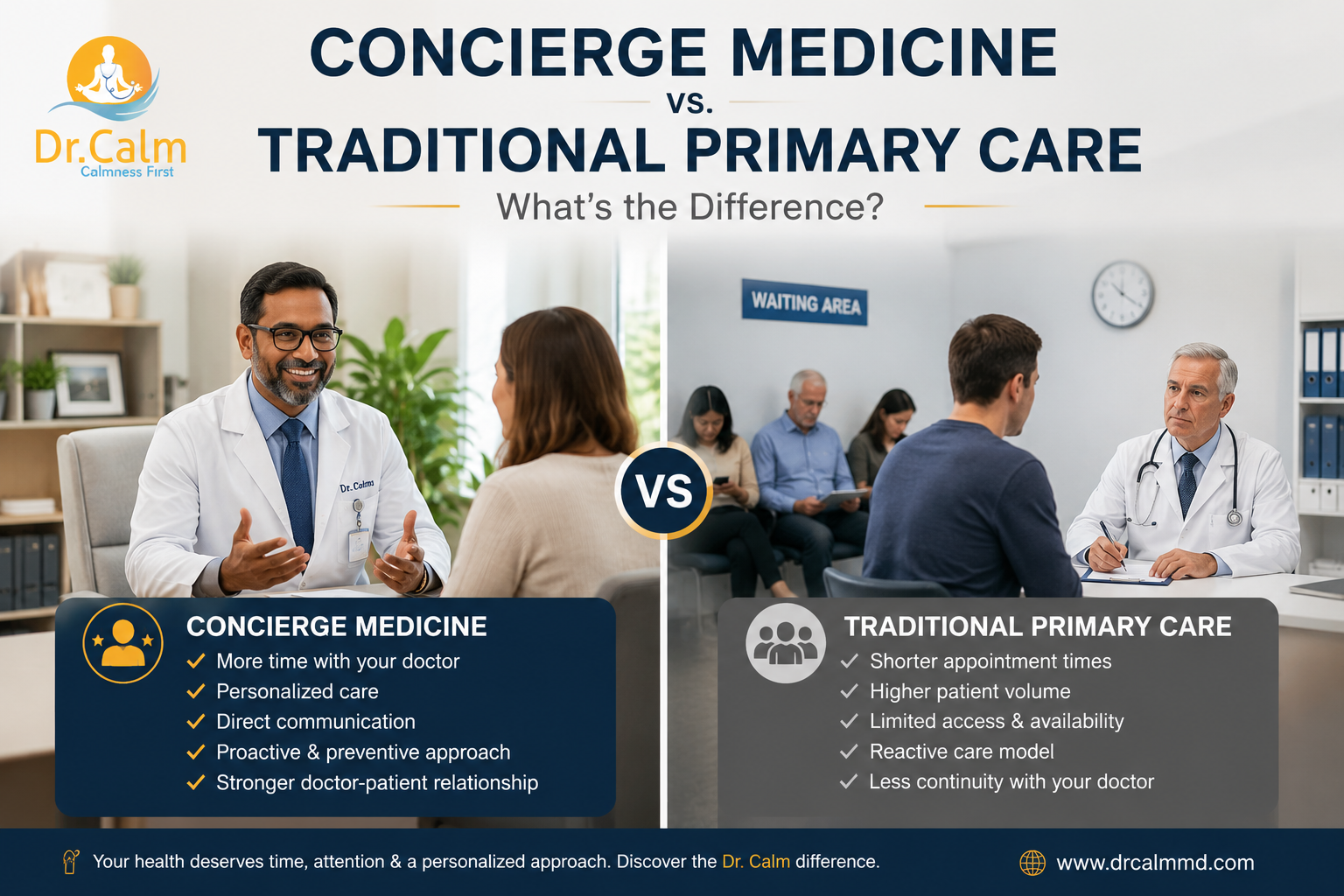
Concierge Medicine vs. Traditional Primary Care
The fundamental difference isn’t necessarily that one provides “better medicine” than the other.
Instead, the models can differ in how care is organized and delivered.
Primary money pages
| Page | Primary keyword | Secondary keywords |
|---|---|---|
| Homepage | Concierge Medicine La Jolla | Concierge Doctor La Jolla, Concierge Healthcare La Jolla |
| Concierge Medicine | Concierge Medicine San Diego | Concierge Doctor San Diego, Personalized Healthcare San Diego |
| La Jolla page | Concierge Doctor La Jolla | Concierge Physician La Jolla, Private Doctor La Jolla |
| San Diego page | Concierge Doctor San Diego | Concierge Medicine San Diego |
| Annual Health Check | Annual Health Check San Diego | Comprehensive Health Assessment, Preventive Health Check |
| Longevity | Longevity Medicine San Diego | Longevity Doctor San Diego |
| Functional Medicine | Functional Medicine San Diego | Functional Medicine Doctor San Diego |
| Stress Management | Stress Management Doctor San Diego | Stress Management Treatment |
| Membership | Concierge Medical Membership | Concierge Care Membership |
| About Dr. Kiran | Dr. Kiran Dintyala | Concierge Physician San Diego |
Important: These are general characteristics. The actual experience can vary considerably between individual practices.
1. Time With Your Physician
One of the most commonly discussed differences between concierge and traditional primary care is the amount of time available for individual appointments.
Traditional primary care practices may manage a large number of patients, and appointment length can vary depending on the practice, physician, and reason for the visit.
Concierge practices often intentionally structure their model around smaller patient panels and more personalized appointments. The AMA has described concierge models as potentially offering unhurried visits and enhanced access, although the specific services depend on the practice.
More time can give patients an opportunity to:
- Explain concerns in greater detail
- Ask questions
- Review medications
- Discuss lifestyle factors
- Review health history
- Discuss preventive care
- Develop longer-term health goals
For patients who prefer a more comprehensive conversation with their physician, this difference may be important.
2. Physician Access and Communication
Access is another area where concierge medicine may differ from traditional primary care.
Traditional practices can offer different communication options, including phone calls, patient portals, telehealth, and office visits. Availability depends on the individual practice.
Concierge practices may provide enhanced communication options as part of their membership structure.
Depending on the practice, this could include:
- Direct communication with the physician
- Secure messaging
- Telephone communication
- Telehealth
- Easier appointment scheduling
- Follow-up communication
The specific communication methods and response times should always be confirmed directly with the practice.
3. Patient-Physician Relationship
A long-term relationship with a physician can be an important part of primary care.
The AAFP identifies continuity of care as an important component of ongoing healthcare and describes it as a long-term partnership between patients and physician-led care teams.
Concierge medicine often places additional emphasis on this relationship.
Because concierge practices may maintain smaller patient panels, physicians may have more opportunity to become familiar with a patient’s medical history, lifestyle, preferences, and long-term health goals.
This can be particularly appealing to patients who value continuity and personalized communication.
4. Preventive Healthcare
Preventive care isn’t exclusive to concierge medicine.
Traditional primary care plays an important role in preventive healthcare, including appropriate screenings, counseling, immunizations, risk assessment, and health maintenance. The U.S. Preventive Services Task Force provides evidence-based recommendations to help clinicians and patients make informed decisions about preventive services.
Concierge medicine may offer a more personalized framework for discussing preventive care and long-term health goals.
At Dr. Calm Clinic, preventive healthcare can be incorporated into a broader personalized approach based on the patient’s medical history, risk factors, lifestyle, and individual goals.
5. Annual Health Assessments
An annual health assessment can be an opportunity to review your overall health rather than focusing on a single concern.
A comprehensive assessment may involve reviewing:
- Medical history
- Current medications
- Family history
- Lifestyle factors
- Preventive screening needs
- Cardiovascular risk factors
- Metabolic health
- Sleep
- Stress
- Nutrition
- Physical activity
The specific tests and screenings that are appropriate depend on the individual patient.
Patients considering concierge care can ask whether the practice offers a comprehensive [annual health assessment], what it includes, and whether additional testing or services have separate costs.
6. Personalized Health Planning
Another potential difference is the amount of emphasis placed on personalized health planning.
Traditional primary care already includes preventive counseling, health maintenance, chronic disease management, and coordination of care.
Concierge practices may build additional time and resources around these activities.
For example, a physician may spend more time discussing:
- Long-term health goals
- Lifestyle changes
- Nutrition
- Physical activity
- Sleep
- Stress
- Preventive strategies
- Risk factors
- Healthy aging
The objective is to create a healthcare plan that reflects the patient’s individual needs rather than taking a one-size-fits-all approach.
7. Cost and Membership Fees
Cost is one of the most important differences patients should understand.
Traditional primary care generally operates through standard insurance and healthcare payment arrangements, although patients may still have copays, deductibles, coinsurance, or other expenses.
Concierge medicine generally involves an additional membership or retainer fee.
That fee may provide access to certain services, appointment structures, communication options, or other benefits defined by the practice.
However, concierge membership fees do not automatically mean that all medical services are included.
Before joining a concierge practice, ask:
- What does the membership include?
- Is insurance accepted?
- Are office visits included?
- Are laboratory tests included?
- Are imaging services included?
- Are specialist visits included?
- Are medications included?
- Are there additional fees?
- What communication options are available?
- What happens if I need hospital care?
Understanding these details can help you compare practices accurately.
8. Is Concierge Medicine Better Than Traditional Primary Care?
There isn’t one answer that applies to everyone.
Traditional primary care may be an excellent choice for patients who are satisfied with their current physician, access, appointment structure, and healthcare coverage.
Concierge medicine may appeal to patients who place a higher value on personalized access, continuity, longer appointments, proactive health planning, and a closer relationship with their physician.
The right choice depends on:
- Your healthcare needs
- Your medical history
- Your preferred level of access
- Your budget
- Your insurance
- Your expectations
- Your preference for physician communication
- Your interest in preventive and long-term health planning
The goal should be finding a healthcare model that provides appropriate, high-quality care and fits your individual circumstances.
Who May Consider Concierge Medicine?
Concierge medicine may be worth exploring if you:
- Prefer a more personalized healthcare experience
- Want more time with your physician
- Value continuity of care
- Want to take a proactive approach to your health
- Prefer more convenient communication
- Have complex or evolving healthcare needs
- Want to discuss long-term health goals
- Are interested in preventive healthcare and healthy aging
- Want a closer physician-patient relationship
It is not necessary to have a complex medical condition to consider concierge care.
Some patients choose the model simply because they prefer a more personalized approach to managing their health.
Questions to Ask Before Choosing a Concierge Doctor
Before joining a concierge practice, don’t focus only on the membership price.
Ask about the complete healthcare experience.
Ask about access
- How quickly can I schedule an appointment?
- How do I contact my physician?
- What happens after normal office hours?
Ask about services
- What is included in the membership?
- Are annual health assessments included?
- Are preventive screenings included?
- Are laboratory tests separate?
- Does the practice coordinate specialist care?
Ask about costs
- What is the annual or monthly membership fee?
- Are there additional charges?
- Does the practice accept insurance?
- Which services are billed separately?
Ask about the physician
- Who will be my primary physician?
- What is their medical background?
- How many patients does the physician serve?
- Will I regularly see the same physician?
Understanding these details can help you determine whether the practice matches your expectations.
Concierge Medicine in La Jolla: A Personalized Approach
For patients in La Jolla who want a more personalized healthcare experience, concierge medicine offers a model centered on physician relationships, preventive care, communication, and individualized health planning.
Dr. Calm Clinic provides concierge healthcare in La Jolla with a focus on personalized and proactive care.
Patients interested in learning more can explore our [concierge medicine in La Jolla] page to understand the approach, services, membership model, and clinic location.
Meet Dr. Kiran Dintyala
Personalized healthcare starts with the physician-patient relationship.
Dr. Kiran Dintyala is the physician behind Dr. Calm Clinic and focuses on understanding each patient’s individual healthcare needs and goals.
His approach incorporates personalized medical care, preventive health, wellness, and long-term health planning.
Learn more about Dr. Kiran Dintyala, his background, and his approach to patient care.
Frequently Asked Questions
What is the main difference between concierge medicine and traditional primary care?
The primary difference is generally the healthcare delivery and payment model. Concierge medicine typically involves a membership or retainer fee and may offer enhanced access, more personalized appointments, and other services defined by the practice. Traditional primary care generally operates through standard insurance and healthcare payment arrangements.
Is concierge medicine the same as direct primary care?
Not necessarily. The terms are sometimes used interchangeably, but many practices and healthcare organizations distinguish between concierge medicine and direct primary care based on payment structure, insurance participation, and services.
Does traditional primary care provide preventive care?
Yes. Preventive care is a core part of primary care and can include health screenings, counseling, immunizations, risk assessment, and health maintenance.
Does concierge medicine replace traditional medical care?
No. Concierge medicine is a model for delivering healthcare, not a replacement for medically necessary care. Patients may still need specialists, emergency care, hospital care, diagnostic testing, or other healthcare services depending on their individual circumstances.
Is concierge medicine more expensive?
Concierge medicine typically involves an additional membership or retainer fee, so the overall cost can be higher than some traditional primary care arrangements. The actual cost depends on the practice, insurance, services, and membership structure.
Is concierge medicine worth it?
That depends on your healthcare needs and priorities. Patients who value personalized access, continuity, longer appointments, and proactive health planning may find the model appealing. Others may prefer traditional primary care.
Can concierge medicine include an annual health assessment?
Many concierge practices offer comprehensive health assessments, but the exact services vary. Patients should ask what is included in the membership and whether laboratory testing, imaging, or other services have separate costs.
How do I choose between concierge medicine and traditional primary care?
Consider your healthcare needs, preferred physician access, communication preferences, budget, insurance coverage, and expectations for preventive and long-term care. Speaking directly with the practice can help you understand whether its model is appropriate for you.
Final Thoughts
Concierge medicine and traditional primary care can both provide valuable healthcare. The key difference is often how the care is structured and experienced, rather than whether one model provides “real” primary care and the other does not.
Traditional primary care emphasizes comprehensive, continuous, accessible healthcare and plays a central role in prevention, chronic disease management, and coordination of care.
Concierge medicine typically adds a membership-based structure and may emphasize personalized access, smaller patient panels, longer visits, and enhanced communication, depending on the practice.
If you value a more personalized approach to healthcare and are considering a concierge physician in the La Jolla area, [learn more about concierge medicine in La Jolla] at Dr. Calm Clinic.
You can also explore our [annual health assessment] options or [meet Dr. Kiran Dintyala] to learn more about our approach to personalized healthcare.
Dr. Calm Clinic
888 Prospect Street, Suite #208
La Jolla, CA 92037
 Previous Post
 Next Post